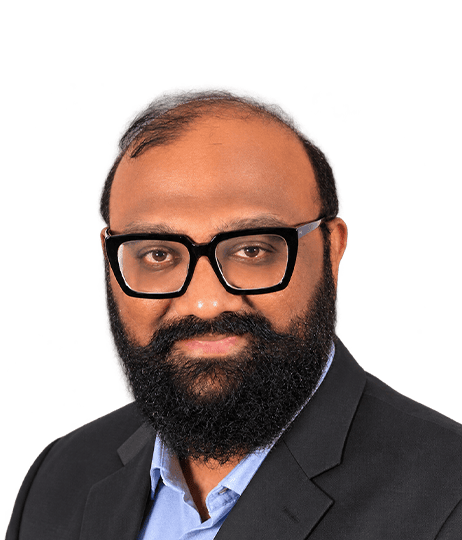
Mr. Nitin Rathnam Rebba is a public health programme leader and operations professional associated with the Piramal Foundation’s Digital Bharat Collaborative, where he serves as Senior Program Director. His work focuses on strengthening healthcare delivery in underserved and remote communities through technology-enabled outreach, mobile medical services, telemedicine and strategic partnerships. With over 15 years of experience in operations and business management, he brings together programme execution, process improvement and large-scale service delivery.
Mr. Nitin Rathnam Rebba is a public health programme leader and operations professional associated with the Piramal Foundation’s Digital Bharat Collaborative, where he serves as Senior Program Director. His work focuses on strengthening healthcare delivery in underserved and remote communities through technology-enabled outreach, mobile medical services, telemedicine and strategic partnerships. With over 15 years of experience in operations and business management, he brings together programme execution, process improvement and large-scale service delivery.
A key aspect of his professional contribution is the development and expansion of last-mile healthcare models. He has been involved in initiatives that use Mobile Medical Units (MMUs) to bring primary healthcare services directly to rural, tribal and geographically isolated populations. These units support basic health screening, diagnosis, treatment of common illnesses, non-communicable disease detection and referrals to appropriate healthcare facilities. His work emphasises the importance of taking healthcare closer to communities that face geographical, economic and infrastructural barriers to accessing conventional medical services.
Mr. Rathnam has also been associated with programmes addressing specific public-health challenges. One such initiative is UNMUKT, a mobile-unit-based sickle-cell screening and counselling programme implemented in collaboration with Novartis. Operating in tribal districts of Jharkhand and Chhattisgarh, the programme focuses on identifying individuals affected by sickle-cell disease and connecting them with appropriate care. A programme update shared by Digital Bharat Collaborative reported that more than 78,800 beneficiaries had been screened across Khunti in Jharkhand and Kanker and Kondagaon in Chhattisgarh over three years.
His work also extends to technology-led healthcare innovation. At the World Health Summit Regional Meeting 2025 in New Delhi, Mr. Rathnam represented Digital Bharat Collaborative in discussions on the role of artificial intelligence and digital technologies in improving non-communicable disease care in rural and tribal India. His contributions highlighted the potential of mobile medical services, telemedicine and digital platforms to strengthen early detection, improve access to specialist advice and support continuity of care in underserved regions.
Another important area of his engagement is collaborative programme development. He has represented Digital Bharat Collaborative in partnerships with organisations such as SJVN Foundation and public-sector enterprises to expand mobile healthcare services. These collaborations have supported initiatives in remote locations, including Arunachal Pradesh and Odisha, with services addressing diabetes, hypertension, high-risk pregnancies and the healthcare needs of elderly populations. Such partnerships demonstrate how corporate social responsibility, technology and public-health expertise can be brought together to extend essential services to communities.
Before his work in the development and healthcare sector, Mr. Rathnam built a professional foundation in operations, quality management and process improvement. His public professional profile lists certifications in Six Sigma, including Black Belt training, and ISO internal auditing. He has also completed the ASCEND 6.0 Harvard Leadership Playbook Programme through Harvard Business Publishing Corporate Learning. These credentials complement his experience in operational planning, performance management and organisational execution.
Mr. Rathnam has also written about the evolution of Piramal Swasthya’s public-health outreach model. His article, Outreach at Scale: The Piramal Swasthya Journey, reflects on the organisation’s work in strengthening public-health delivery through community engagement and scalable service models. This contribution highlights his involvement not only in programme implementation but also in documenting and communicating the approaches that can improve healthcare access across diverse geographies.
Through his leadership at Piramal Foundation’s Digital Bharat Collaborative, Mr. Nitin Rathnam contributes to efforts to make healthcare more accessible, responsive and inclusive. His work brings together operational excellence, technology-enabled service delivery, corporate partnerships and community-level engagement. His professional journey reflects a commitment to strengthening public-health systems and ensuring that people in remote and underserved parts of India are not left behind in accessing essential healthcare.